Skip to content

Engineered for clean energy

ENplus A1 wood pellets, direct from our mill.

Certified 6 mm pellets pressed from 100% pine and spruce stem wood, 0.30% ash, 5.0 kWh/kg, 98.6% durability. Supplied on 975 kg pallets, in big bags and by the full truck load, priced per tonne and delivered across Europe.

The wood pellet production cycle: managed forest, sawmill by-products, pressing, and 15 kg bagged pellets returning carbon absorbed during tree growth
  • 21 years producing pellets, since 2005
  • 15 export markets served
  • 0.30% ash content, against a 0.7% ENplus A1 limit
  • 100% pine and spruce, milled in Estonia

Standardised fuel formats

The same ENplus A1 pellet in two formats: bagged pallets for retail and domestic customers, and big bags for automated hoppers. Both are priced per tonne so you can compare them directly against any other offer on your desk.

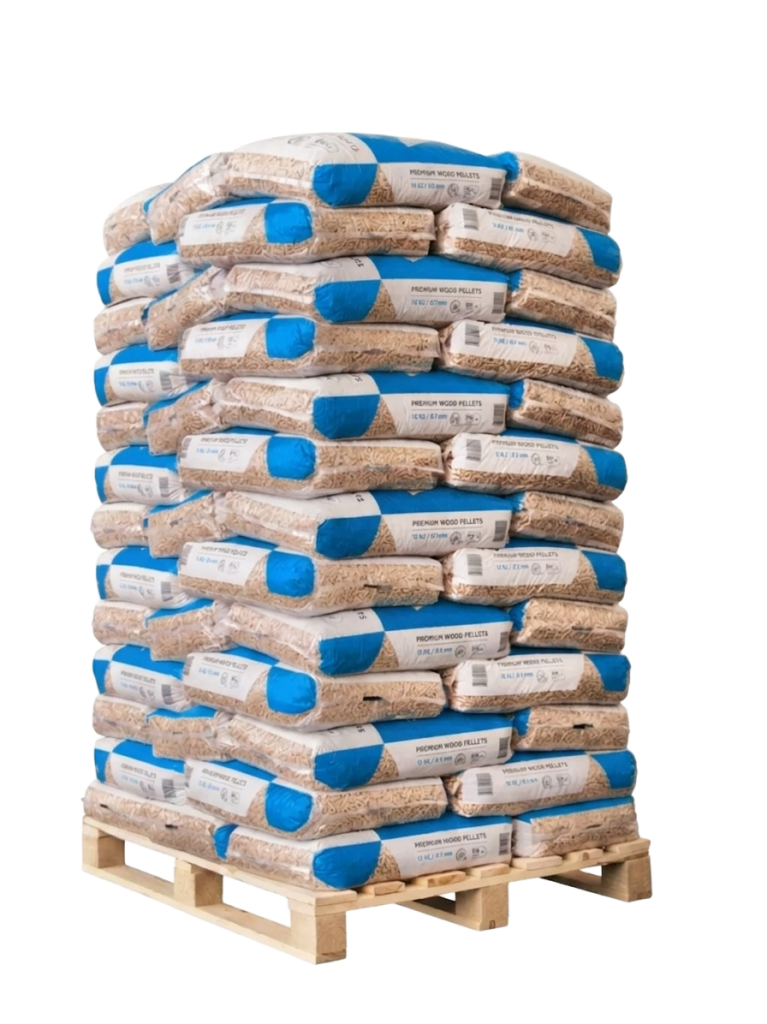
Premium Wood Pellets – Full Pallet (65x15kg) Bags

ENplus A1 certified 6 mm pellets in 65 bags of 15 kg, 975 kg net on a shrink-wrapped…
In stock
Premium Wood Pellets – Full Pallet (65x15kg) Bags — ENplus A1 certified 6 mm wood pellets made from Estonian pine and spruce

100% pine and spruce · Made in Estonia · ENplus A1

Pellet diameter
6 mm
Bag weight
15 kg
Calorific value
5.00 kWh/kg
Moisture
5.50 %
Durability
98.60 %
Weight per unit
15 kg
Price 290,00 €
Per tonne, excl. VAT € 400.00

Full specification and datasheet →
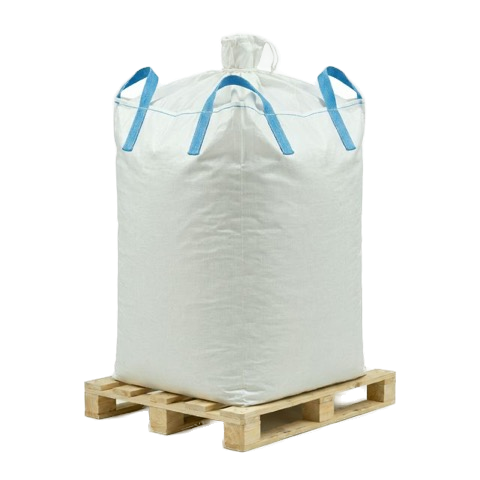
Bulk Big Bag

The same ENplus A1 6 mm pellet supplied in bulk totes for automated hoppers and silo filling. Less…

In stock
Bulk Big Bag — ENplus A1 certified 6 mm wood pellets made from Estonian pine and spruce

100% pine and spruce · Made in Estonia · ENplus A1

Pellet diameter
6 mm
Bag weight
100 kg
Calorific value
5.00 kWh/kg
Moisture
5.50 %
Durability
98.60 %
Price 265,00 €
Per tonne, excl. VAT € 400.00

Full specification and datasheet →

Fuel specification

Every batch is pressed from debarked pine and spruce stem wood and tested before dispatch. The table below sets our measured values against the ENplus A1 limits, so you can see where we sit inside the class rather than just that we are inside it.

Measured pellet properties compared with the ENplus A1 limits
Property Our value ENplus A1 limit
Diameter 6 mm 6 ± 1 mm
Length 3.15 – 40 mm 3.15 < L ≤ 40 mm
Moisture 5.50 % (better than the class limit) ≤ 10 %
Ash content 0.30 % (better than the class limit) ≤ 0.7 %
Mechanical durability 98.60 % (better than the class limit) ≥ 98.0 %
Fines (< 3.15 mm) 0.50 % (better than the class limit) ≤ 1.0 %
Bulk density 650 kg/m³ 600 – 750 kg/m³
Net calorific value 5.0 kWh/kg (better than the class limit) ≥ 4.6 kWh/kg
Raw material 100 % pine and spruce Stem wood, chemically untreated

Why ash content matters

Ash is the residue left after combustion, and it drives almost everything an operator notices day to day: how often the burn pot needs scraping, how often the ash pan needs emptying, and whether clinker forms and blocks the grate. ENplus A1 permits up to 0.7%. At 0.30% we sit at roughly the level of the best Baltic producers, which in practice means a domestic boiler needs cleaning around half as often as it would on a pellet sitting at the class limit.

The reason is the raw material rather than the press. Debarked pine and spruce stem wood carries very little mineral content, whereas bark, forest residues and recycled fibre all raise the ash figure. We do not blend them in.

Moisture, durability and fines

Moisture at 5.5% is well inside the 10% ceiling. Dry pellets carry more usable energy per kilogram, because none of the calorific value is spent boiling off water, and they resist swelling in storage. Mechanical durability of 98.6% and a fines fraction of 0.5% mean the pellets survive handling: they arrive as pellets rather than as dust, which is what keeps auger feeds and pneumatic transfer running without jams.

Certification and quality control

A certification is only worth as much as the number behind it, which is why every certificate we hold is published here with its identifier. You can verify each one against the issuing body’s own register before you place an order.

What ENplus A1 actually guarantees

ENplus is a certification scheme rather than a self-declared quality claim. It covers the whole chain — production, storage, bagging and transport — and every certificate holder is audited annually by an independent inspection body, with samples pulled and tested against ISO 17225-2. A producer who drifts outside the limits loses the certificate.

That matters commercially as well as technically. Many EU boiler manufacturers make warranty cover conditional on burning certified A1 fuel, and several national subsidy schemes require it. Buying uncertified pellets can quietly invalidate both.

How we test

Moisture and durability are checked in-house on every production shift, and samples go to an accredited external laboratory for the full parameter set — ash, calorific value, fines, bulk density, ash melting behaviour and trace elements. Results are archived per batch, so a delivery can be traced back to the shift that produced it.

If your own quality department needs the raw certificates of analysis for incoming goods inspection, ask for them with your quotation and we will include them.

Packaging and pallet configuration

Our bagged unit is 65 bags of 15 kg, giving 975 kg net on a shrink-wrapped, non-returnable pallet.

Typical pallet configuration by market
Market Typical pallet Net weight
Poland 65 × 15 kg 975 kg
Germany 66 × 15 kg 990 kg
Italy 70 – 80 × 15 kg 1,050 – 1,200 kg
United Kingdom & Ireland 70 × 15 kg 1,050 kg

This is why we quote in euro per tonne rather than per pallet. A pallet price on its own tells you nothing until you know how many kilograms are on the pallet, a 975 kg unit and a 1,200 kg unit are not comparable line items.

How the pellet ships

  • Bagged pallets 65 × 15 kg polyethylene bags, 975 kg net, hooded and strapped for outdoor handling. The format retailers and domestic customers expect.
  • Big bags Bulk totes for automated hoppers and silo filling. Less packaging per tonne and faster to discharge, provided you have a forklift or crane with the reach to lift them.
  • Full truck and container loads Shipped direct from the mill with no intermediate handling. This is where the price per tonne is lowest — ask us for the current load configuration and tonnage.

Delivery, Incoterms and payment

Everything below is what we would otherwise have to tell you on a phone call. Published terms make it easier to work out whether we are a fit before either of us spends time on a quotation. Every order is placed online and shipped from Estonia to an address you nominate, we do not offer collection.

Minimum order

On request

Smaller orders are possible for customers inside a delivery round we are already running. Tell us the destination and we will say either way.

Lead time

On request

Lead times stretch through the autumn peak, when demand across the whole of Northern Europe lands in the same eight weeks.

Incoterms

On request

Quote us your preferred term and delivery point and we will price against it, so you are comparing like with like rather than untangling who pays for what.

Wholesale pricing and how to order

The figures below are indicative and exclude VAT and freight. Pellet is a commodity and the market moves through the season, so the binding number is always the one on your quotation, but these are close enough to tell you whether it is worth asking.

Indicative wholesale prices by format, excluding VAT
Format Unit price, excl. VAT Per tonne, excl. VAT
Premium Wood Pellets – Full Pallet (65x15kg) Bags 290,00 € € 400.00
Bulk Big Bag 265,00 € € 400.00

What moves the price

Three things, in order of size. Volume comes first, a full truck load carries the lowest cost per tonne. Distance comes second, since freight is a real share of the delivered price on a low-value, high-weight commodity. Timing comes third and is the one most buyers underestimate: prices across Northern Europe rise sharply once the heating season starts and everyone tries to buy at once.

If your storage allows it, contracting in spring or early summer is consistently the cheapest way to buy pellets.

Getting a quotation

  1. Tell us the format, the tonnage and the delivery address, the inquiry form on this page captures all three.
  2. We come back with a price per tonne against your Incoterm, a lead time and the current test report.
  3. You confirm, we schedule the load and send the pro forma invoice.
  4. We give you a delivery window in advance so someone can be on site to unload.

Request a quote

ENplus A1, A2 and B: what actually differs

The three ENplus classes are often presented as good, better and best. They are not really a quality ladder, they are three different fuels intended for three different kinds of equipment, and putting the wrong one in a boiler causes problems that have nothing to do with the pellet being bad.

Comparison of the ENplus A1, A2 and B fuel classes
Property ENplus A1 ENplus A2 ENplus B
Ash content ≤ 0.7 % ≤ 1.2 % ≤ 2.0 %
Moisture ≤ 10 % ≤ 10 % ≤ 10 %
Net calorific value ≥ 4.6 kWh/kg ≥ 4.6 kWh/kg ≥ 4.6 kWh/kg
Mechanical durability ≥ 98.0 % ≥ 97.5 % ≥ 97.5 %
Raw material Stem wood, chemically untreated residues Whole trees without roots, forest residues Also recycled and industrial wood by-products
Typical use Domestic boilers and stoves Larger domestic and small commercial boilers Commercial and industrial plant only

Why the class matters in a domestic boiler

Domestic stoves and boilers have small burn pots, narrow feed augers and modest ash pans, and they are calibrated at the factory for A1 fuel. Feed them A2 or B and the extra mineral content produces more ash and, above a certain temperature, clinker — fused ash that welds itself to the grate and has to be chipped off. The appliance has not failed; it is simply being asked to burn something it was not designed for.

We produce A1 only, so the question does not arise.

Where A2 and B belong

A2 suits larger domestic and small commercial boilers with automated de-ashing and enough grate area to cope with a higher ash load. Class B is an industrial fuel: it permits chemically treated and recycled wood, and it belongs in plant with flue gas treatment fitted to handle the resulting emissions. It should never go into a domestic appliance.

When you compare offers, check the class before you compare the price. A quote that undercuts the market by a wide margin is usually quoting a different fuel, not a better deal.

Biogenic
CO₂
Atmosphere
Fossil
CO₂
Fossil fuels

The biogenic carbon advantage

Unlike fossil fuels, which release carbon that has been locked underground for millions of years, biomass burns inside the active carbon cycle. The CO₂ released during combustion is the same carbon the tree absorbed while it grew, which is why pellets are counted as carbon neutral in EU renewable energy accounting.

  • Closed-loop raw materialWe press sawmill by-products and shavings, the residue of timber already harvested for other uses. No roundwood is felled to make our pellets.
  • High-efficiency processingDrying and pressing run on heat recovered inside the plant, which keeps the embedded carbon footprint of each tonne low.
  • Traceable forestryRaw material comes from managed Estonian forests where replanting is a legal condition of harvest, so the absorbing side of the cycle keeps running.

Frequently asked questions

The questions buyers ask us most often, answered in full. If yours is not here, the inquiry form goes straight to the sales desk.

A standard pallet holds 65 bags of 15 kg, so 975 kg of pellets net. Pallet configurations differ by market — Germany usually quotes 66 bags (990 kg) and Italy 70 to 80 bags — so when you compare offers, compare the price per tonne rather than the price per pallet.

Minimum order quantity depends on the format and the destination. Send us the volume and delivery address through the inquiry form and we will confirm what we can ship and at what price per tonne.

A typical detached house burns 2 to 3 tonnes across a heating season, which is roughly two to three pallets, or 130 to 200 bags of 15 kg. Consumption depends on floor area, insulation and how cold the winter is, so treat this as a planning figure rather than a guarantee.

The classes differ mainly in ash content and permitted raw material. A1 allows up to 0.7% ash and only chemically untreated stem wood, which is what domestic boilers and stoves are designed for. A2 allows up to 1.2% ash and wider forest residues. Class B allows up to 2.0% ash and is intended for commercial and industrial plant. We produce A1 only.

Pallets ship shrink-wrapped on a curtain-side trailer. You need firm, level access for an articulated lorry and either a forklift or a pallet truck with a tail lift. Tell us in advance if the site cannot take a full-size vehicle so we can plan the delivery.

No. We are a wholesale supplier working on an order-and-deliver basis. Every order starts with the inquiry form on this site or an email to the sales desk, and every load is delivered to an address you give us. We do not operate a sales counter, do not sell on site and do not release orders for collection. Our Tallinn address is the registered office of the company, not a sales point.

Intra-community supplies to a business with a valid EU VAT identification number are invoiced at 0% VAT under the reverse charge, and you account for VAT in your own country. Supplies to customers without a valid VAT number are invoiced with Estonian VAT. We confirm the VAT treatment on every quotation.

Keep pellets dry and off the ground, indoors or under cover. Pellets absorb atmospheric moisture, and damp pellets swell, crumble into fines and jam auger feeds. Leave the shrink wrap on until you need the bags, and try to use an opened pallet within the same heating season.

Almost every domestic stove and boiler is built around 6 mm, which is what we produce. 8 mm is generally used in larger commercial burners with wider feed augers. Check the manufacturer’s manual before switching diameter, because feed rate and combustion settings are calibrated for one or the other.
QUICK RESPONSE

Send an Inquiry

Tell us the format, the volume and the delivery country. We reply with a price per tonne. Orders are placed online and delivered.